

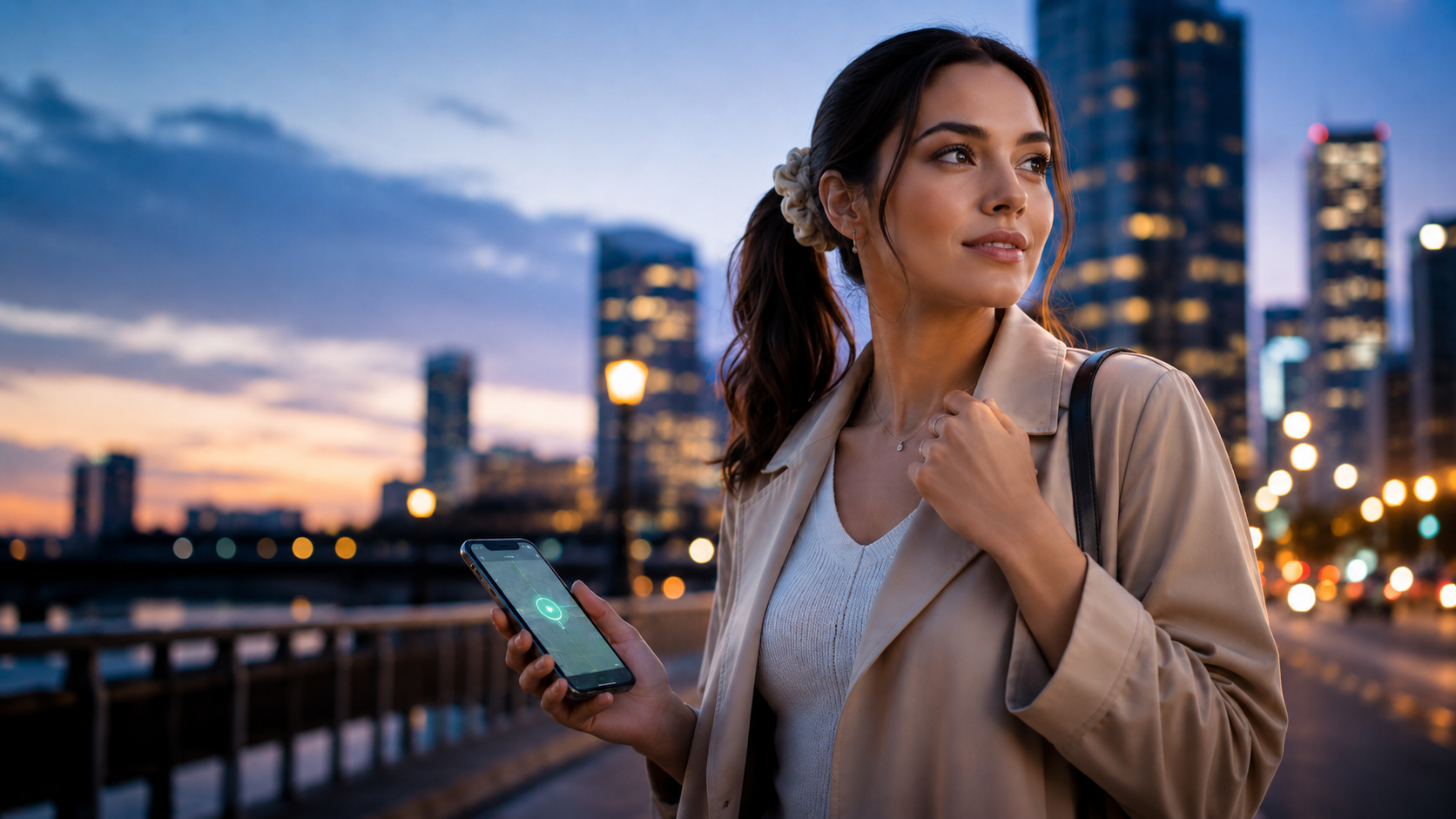
In an emergency situation, taking out your cell phone, unlocking it, finding a contact, and explaining where you are can be difficult. Therefore, more and more people are looking for a personal panic button that allows them to ask for help quickly, discreetly and easily.
These security devices are no longer limited to large alarms installed in homes or businesses. There are now wearable emergency buttons that can be worn on a bracelet, keychain, necklace, sports band, or even a scrunchie.
The purpose is simple: allow a person to send a warning signal to their trusted contacts when they need help.
What is a personal panic button?
A personal panic button is a safety device designed to activate an emergency alert with a simple press.
Depending on the system, the alert can reach family members, trusted contacts, a monitoring center or a previously configured organization. Some devices also allow user location sharing to facilitate quick response.
Unlike a residential alarm, a portable panic button accompanies the person while they walk, use public transportation, play sports, travel or carry out their daily activities.
That is why terms such as:
- SOS button.
- Emergency button.
- Personal alert device.
- Personal alarm.
- Safety wearable.
- Security device with location.
- Portable emergency button.
Although the names may change, they all seek to solve the same need: ask for help in as few steps as possible.
How does a panic button work?
The operation will depend on each device. Some buttons are connected to an alarm installed in a home, while others use mobile networks, Wi-Fi or Bluetooth.
In the case of a device connected to a mobile application, the process typically works as follows:
- The user previously configures their emergency contacts.
- The panic button connects to the cell phone.
- The person activates the device in a risky situation.
- The system generates an alert.
- Contacts receive a help message and, when the service allows it, the person's location.
The main advantage is that the configuration is done in advance. Thus, when an emergency occurs, the user does not have to write a message, explain the situation or manually search for their location.
It is important to remember that not all panic buttons connect directly to Carabineros, ambulances or public services. Before purchasing one, you should clearly review who receives the alert and what information will be sent.
What is the difference between an app and a physical panic button?
There are personal security applications that allow you to share your location or send an alert from your cell phone. However, they usually require finding the phone, unlocking it, and opening the app.
A physical panic button It remains accessible on an object that the person wears or keeps nearby. This can facilitate its activation when there is nervousness, little time or difficulty using the phone.
Both solutions can complement each other. The application allows you to configure and manage the system, while the physical device provides a more direct way to activate the alert.
The choice will depend on the context, but for many people accessibility is a decisive factor: a security device is only useful if it can be activated when it is really needed.
Is a panic button the same as a GPS?
Not necessarily.
A GPS or tracker is primarily designed to query or record the location of a person or object. On the other hand, a panic button is designed so that the user voluntarily activate an emergency signal.
Some devices combine both functions and share the location when an alert is generated. However, that does not mean that they carry out permanent monitoring.
For example, ALARA does not work as a tracker that constantly shows where a person is. Location is shared with emergency contacts during an active alert state. In this way, the system is aimed at requesting help and not at permanently monitoring the user's movements.
Why is it important to be discreet?
In a risky situation, a device that is too obvious could be difficult to activate without attracting attention. Therefore, discretion is an important characteristic in a personal safety device.
A button integrated into an everyday accessory can always be available without seeming like an alarm. The person can wear it on their wrist, hair, neck, keys or clothing, depending on the format chosen.
Discretion also favors daily use. Many people stop carrying certain devices because they are large, uncomfortable, or difficult to combine with their activities. On the other hand, an accessory that is part of the routine is more likely to be available when needed.
Who can use a personal safety device?
A panic button is not designed exclusively for one type of person. It can be useful at different times and activities.
People who move alone
It can be used when walking, returning home at night, waiting at a stop, taking public transportation or traveling through mobility applications.
Women looking for greater peace of mind on their journeys
A safety device for women can make it easier to send an alert in case of harassment, threats, violence or any situation that creates danger.
It does not replace preventive measures or action by authorities, but it adds a tool to quickly notify a trusted network.
Older adults
A panic button for seniors can help call for assistance in the event of a fall, disorientation, sudden illness, or any home emergency.
For this use, it is especially important that the device is easy to press, has good autonomy and can be worn comfortably during the day.
Students and young people
You can accompany them during trips to school, institute or university, especially when they begin to move without company.
Athletes
Those who run, cycle, trek or train outdoors can use an SOS button to notify their contacts in the event of an accident or unexpected situation.
Workers exposed to risk situations
Drivers, real estate brokers, health care personnel, night workers and field visitors may need a quick and discreet way to call for help.
People with medical conditions or disabilities
In some cases, an alert device can allow family members or caregivers to be notified when the person has an emergency and cannot make a call.
What features should a good panic button have?
Before choosing a personal safety device, it is worth checking more than its appearance. These are some of the most relevant features.
Simple activation
The alert must be able to be activated with few movements. A mechanism that is too complex can be difficult to use in a stressful situation.
Quick access
The device must be within reach. Storing it in the bottom of a backpack can reduce its usefulness.
Location Send
Sharing real-time location helps contacts know where the person is, especially if they are on the move or unable to explain their location.
Previously configured contacts
It is recommended that the system allows you to select a network of trusted people before an emergency occurs.
Good battery life
A safety device must be available for long periods and provide timely warning when its battery needs to be replaced or charged.
Cell phone compatibility
Before purchasing, you should check that the application is compatible with the phone's operating system and know the permissions it needs to work.
Discretion and comfort
The format must adapt to the user's routine. This can be a necklace, bracelet, keychain, scrunchie, sports band or other accessory.
Periodic tests
Every emergency device should be tested regularly. This allows you to check the connection, battery status, app permissions, and that contacts are up to date.
What is ALARA and how does it work?
ALARA is a personal panic button integrated into jewelry and everyday accessories. It was developed to make asking for help faster, discreet and more accessible.
The device connects via Bluetooth to the ALARA application installed on the cell phone. The user pre-registers up to five emergency contacts.
When you need help, make two or more presses on the device. After this activation, your contacts receive a help message with your location in real time.
The link sent allows you to track the location during the alert state. If the alert is not stopped manually from the app, it ends automatically after 24 hours.
ALARA can be carried in different formats, including:
- Scrunchie.
- Sports band.
- Key ring.
- Bracelet.
- Necklace.
- Formats developed for older people.
This variety allows each person to choose the accessory that is easiest to integrate into their daily life.
What does ALARA need to work?
ALARA uses the cell phone connection to generate and send alerts. Therefore, the phone must remain on, connected to the device and with access to the internet.
The necessary Bluetooth, location, and app operation permissions must also be enabled. The device must remain within the Bluetooth connection range corresponding to its model.
The battery is replaceable and can last up to 12 months, depending on use. ALARA uses a CR1220 battery and does not require daily charging of the device.
In addition, it works with Android phones and iPhones and does not require monthly payments to use its main functions.
What happens when an ALARA alert is activated?
When the user activates their panic button:
- The application detects the activation.
- An SMS is sent to the configured emergency contacts.
- The message includes a link with the real-time location.
- Contacts can indicate if they are available to help.
- The response appears in the user's application.
- The location continues to be shared as long as the alert remains active.
This allows multiple people to be aware of the situation and coordinate a response.
ALARA does not replace Carabineros, ambulances or other emergency services. In the event of a serious situation, contacts must contact the corresponding services and follow the applicable protocols.
Situations in which a panic button can be used
An alert device can be activated in different emergencies, for example:
- Feeling followed or threatened.
- In the event of a robbery or attempted assault.
- During a bullying situation.
- Faced with an episode of violence.
- After a fall or accident.
- In the event of a sudden medical discomfort.
- When getting lost or disoriented.
- During a journey that does not feel safe.
- When it is not possible to make a call.
- When you need family or contacts to quickly know the location.
There is no need to wait for a situation to escalate to ask for help. The emergency network must previously define what actions it will take when receiving an alert.
How to prepare your emergency contacts
Buying a panic button is only part of the preparation. Contacts also need to know what to do.
Before using the device, talk to them and agree on a protocol. For example:
- Try to communicate with the person.
- Review the location received.
- Confirm who is available to help.
- Contact Carabineros, municipal security or medical services when appropriate.
- Avoid exposing yourself directly to a dangerous situation.
- Keep your phone numbers updated.
It is also advisable to carry out periodic tests so that everyone recognizes the message and knows how to access the map.
Panic Button FAQ
Does the panic button work without a cell phone?
It depends on the model. Some devices have their own mobile connection, while others are linked to a phone. ALARA needs to be connected to a cell phone turned on, with Bluetooth, location, active application and internet access.
Do contacts need to have the ALARA app installed?
No. Contacts receive an SMS with a link that allows them to access the shared location during the alert.
How many emergency contacts can be configured?
The ALARA application allows you to register up to five trusted contacts.
How long is location shared?
Location is shared as long as the alert status is active. If the user does not stop it manually, the alert ends automatically after 24 hours.
Does ALARA call Carabineros directly?
The ALARA standard service sends the alert to the contacts configured by the user. It does not automatically contact Carabineros or an ambulance, unless there is a specific institutional protocol associated with the device.
Does ALARA have a monthly payment?
No. The use of the main functions of the device does not require a monthly payment.
Does it serve as a permanent tracker?
No. ALARA is a panic button and alert device, not a permanent monitoring or surveillance system. Share the location when there is an active alert.
Can it be used outside of Chile?
Yes. It can work in other countries as long as the cell phone is compatible, has an internet connection and has the necessary configuration.
Personal security at your fingertips
A personal panic button cannot prevent all risky situations, but it can reduce the steps necessary to call for help.
The possibility of carrying the device in an everyday accessory, activating it with a simple gesture and sharing the location with a trusted network transforms the SOS button into a practical tool for daily life.
ALARA integrates this technology in discreet formats designed to accompany women, men, young people, older adults, athletes, workers and families.
Because when every second counts, asking for help should be simple.
Learn about ALARA personal safety devices and find the format that best suits your life.
Share:
Father's Day: giving security is also a way of saying “I love you”
ALARA and the Municipality of Ñuñoa promote security devices to protect women