

30%.
That is the percentage of adults over 65 years of age who suffer at least one fall per year in Chile, according to data from the Ministry of Health.
But the number we should really worry about is this: 40% of them were alone on the floor for more than an hour before receiving help.
One hour.
Sixty minutes wondering if anyone is going to arrive. If they can get up on their own. If this is "the moment" that everyone talks about but no one wants to name.
This article is not to scare you. It's to prepare you. because The difference between a fall that is just a scare and a fall that changes everything is often the first 10 minutes.
If you have parents, uncles or grandparents over the age of 65 living alone or spending long periods without company, this information could literally save their lives.
THE REALITY OF FALLS IN CHILE: BEYOND THE STATISTICS
When we read "1 in 3 older adults falls," the brain processes it as an abstract statistic. Until it happens to your mom.
Specific data in Chile (SENAMA 2023):
- 📊 33% of adults over 65 years of age suffers at least one annual fall
- 📊 50% of those over 80 years old falls at least once a year
- 📊 43% of falls occur within the home (bathroom and stairs, mainly)
- 📊 15-20% of falls result in fractures (hip, wrist, skull)
- 📊 40% of those hospitalized due to falls does not live independently again
But the most shocking fact is not how many fall. It is how long they spend on the floor before receiving help.
WHY TIME ON THE FLOOR IS CRITICAL
"Prolonged Immobility Syndrome" - it sounds technical, but it's simple and terrifying:
When an older adult falls and cannot get up, every hour on the floor:
✗ Increases the risk of severe dehydration by 50%
✗ Increases likelihood of pressure ulcers (sores that become infected)
✗ Generates hypothermia (even indoors, body temperature drops)
✗ Increases the risk of pneumonia (due to being in a prolonged horizontal position)
✗ Creates "post-fall syndrome" = paralyzing fear of falling again
Anonymous real case (Hospital Clínico U. de Chile, 2023):
"76-year-old woman, self-sufficient, fell in her bathroom on a Friday at 6:00 p.m. She lives alone. Her daughter visits her on Sundays. They found her 40 hours later. She survived, but the psychological trauma was such that she is now afraid of being alone. She left her home and independence. All for 40 hours."
The difference is made by the response time.
THE 5 MOST COMMON CAUSES OF FALLS (AND HOW TO PREVENT THEM)
1. OBSTACLES AT HOME (35% of cases)
Frequent culprits:
- Rugs that lift up in the corners
- Lamp/charger cords on the floor
- Small pets underfoot
- Objects stored in high places (requires stretching)
- Insufficient lighting in corridors at night
Practical prevention:
✅ Remove all rugs or secure them with double-sided non-slip tape
✅ Pass cables through channels attached to the baseboard
✅ Automatic night light (motion sensor) in hallway to bathroom
✅ Reorganize kitchen: what they frequently use at chest height
✅ Install railings in long hallways (not just stairs)
2. BALANCE AND MUSCLE STRENGTH PROBLEMS (30%)
Warning signs:
- They lean on furniture when walking around the house
- They use both hands to get up from the chair
- They walk slower than before (especially when turning)
- They have difficulty getting into the car or bus
Practical prevention:
✅ Supervised balance exercise: stand on one foot for 10 seconds (with support nearby)
✅ Short daily walks are better than long weekly ones
✅ Tai Chi or yoga for the elderly (reduces falls by 43% according to studies)
✅ Annual evaluation with a kinesiologist
✅ Alert device when they go out for a walk alone (see final section)
3. SIDE EFFECTS OF MEDICATIONS (20%)
High-risk medications:
- Antihypertensives (lower blood pressure = dizziness when standing)
- Sedatives and sleeping pills (affect balance)
- Antidepressants (some cause postural dizziness)
- Diuretics (dehydration = weakness)
Practical prevention:
✅ Annual pharmacological review with geriatrician
✅ Never self-medicate or share medications
✅ Get up slowly: sit 30 seconds before standing
✅ Taking medications with food if they cause dizziness
✅ If they take 4+ medications, they need a quick way to ask for help if they feel sick
4. SLIPPERY BATHROOMS (43% of domestic falls)
Why the bathroom is a high-risk area:
- Wet surfaces + bare feet = slipping
- They enter and exit the shower/tub (height change)
- Many times with steam = reduced visibility
- They are alone and do NOT carry their cell phone
Practical prevention:
✅ Support bars in the shower AND next to the toilet
✅ Non-slip mat INSIDE the shower
✅ Shower seat (avoids standing throughout the bathroom)
✅ Unlock the door (so that it can be opened from the outside)
✅ Waterproof alert device (see final section)
5. VISION PROBLEMS (15%)
Visual factors that increase falls:
- Unoperated cataracts (blurred vision)
- Glaucoma (loss of peripheral vision)
- Outdated lenses (more than 2 years ago)
- Light/shadow transition (entering the house with sun outside)
Practical prevention:
✅ Annual ophthalmological check-up (not every 3 years)
✅ Lenses with UV protection (reduces visual fatigue)
✅ Good lighting throughout the house, not just the living room
✅ Paint the edge of the steps a contrasting color
✅ Avoid walking with direct sun in your eyes (cap/glasses)
WHAT TO DO IF YOUR DADDY/MOM FALLS: 3 MINUTE PROTOCOL
MINUTE 1 - IMMEDIATE EVALUATION (Do not move them yet)
📞 Call or ask them to call 131 (SAMU) immediately if:
- He lost consciousness (even if it was for seconds)
- You are confused or don't remember how you fell
- You have severe pain in your hip, back, or head
- Cannot move any limbs
- There is bleeding that does not stop with pressure
If you do NOT have these symptoms, continue to minute 2.
MINUTE 2 - COMMUNICATION AND CALM
✅ Question: "Does something specific hurt you?"
✅ Check visually: Is there obvious swelling or deformity?
✅ If you have been on the floor for more than 30 minutes: call 131 anyway (risk of hypothermia)
✅ If you are conscious and without severe pain: "We are going to get you up slowly, but first rest for 1 minute"
MINUTE 3 - GET UP GRADUALLY (Only if there is no pain)
- Help them turn on their side
- Get them on their hands and knees (crawling position)
- Pull out a sturdy chair
- Have them lean on the chair to raise one knee
- From there, push yourself to sit
- Sitting, wait 2-3 minutes before standing up
AFTER LIFTING THEM:
- ❌ "You're fine, it was nothing" → minimizing normalizes the risk
- ✅ Medical check-up even if "it seems like nothing" → hidden fractures exist
- ✅ Analyze: Why did it fall? → prevent the next
THE QUESTION EVERYONE AVOIDS: "WHAT IF THEY ARE ALONE WHEN IT FALLS?"
Here's the awkward conversation every family needs to have:
Your mom lives alone. He falls in the bathroom. He can't get up. How do you ask for help?
❌ "You can call from your cell phone"
→ His cell phone is on the living room table. She is in the bathroom.
❌ "She can scream and the neighbors can hear her"
→ In modern apartments with good insulation, no one listens.
❌ "It can crawl to the phone"
→ If you have a hip fracture, moving is impossible and aggravates the injury.
The awkward answer: If they don't have a way to ask for help that is ALWAYS with them, they are at risk.
TECHNOLOGY THAT SAVES LIVES WITHOUT INVADING PRIVACY
There are basically 3 types of technological solutions. Here is the unfiltered reality:
OPTION 1: Traditional telecare services
📱 What are they: Pendant with button that calls the monitoring center
💰 Cost: $15,000-30,000 CLP/month
✅ Pro: Human operator responds
❌ Against: Medical design (they don't want to use it), expensive subscription, slow response
OPTION 2: Smart home cameras and sensors
📱 What are they: Cameras + motion sensors at home
💰 Cost: $150,000-500,000 CLP installation + internet
✅ Pro: Automatically detect falls
❌ Against: Invasive (they are recording them 24/7), high psychological rejection
OPTION 3: Wearable devices with alert button
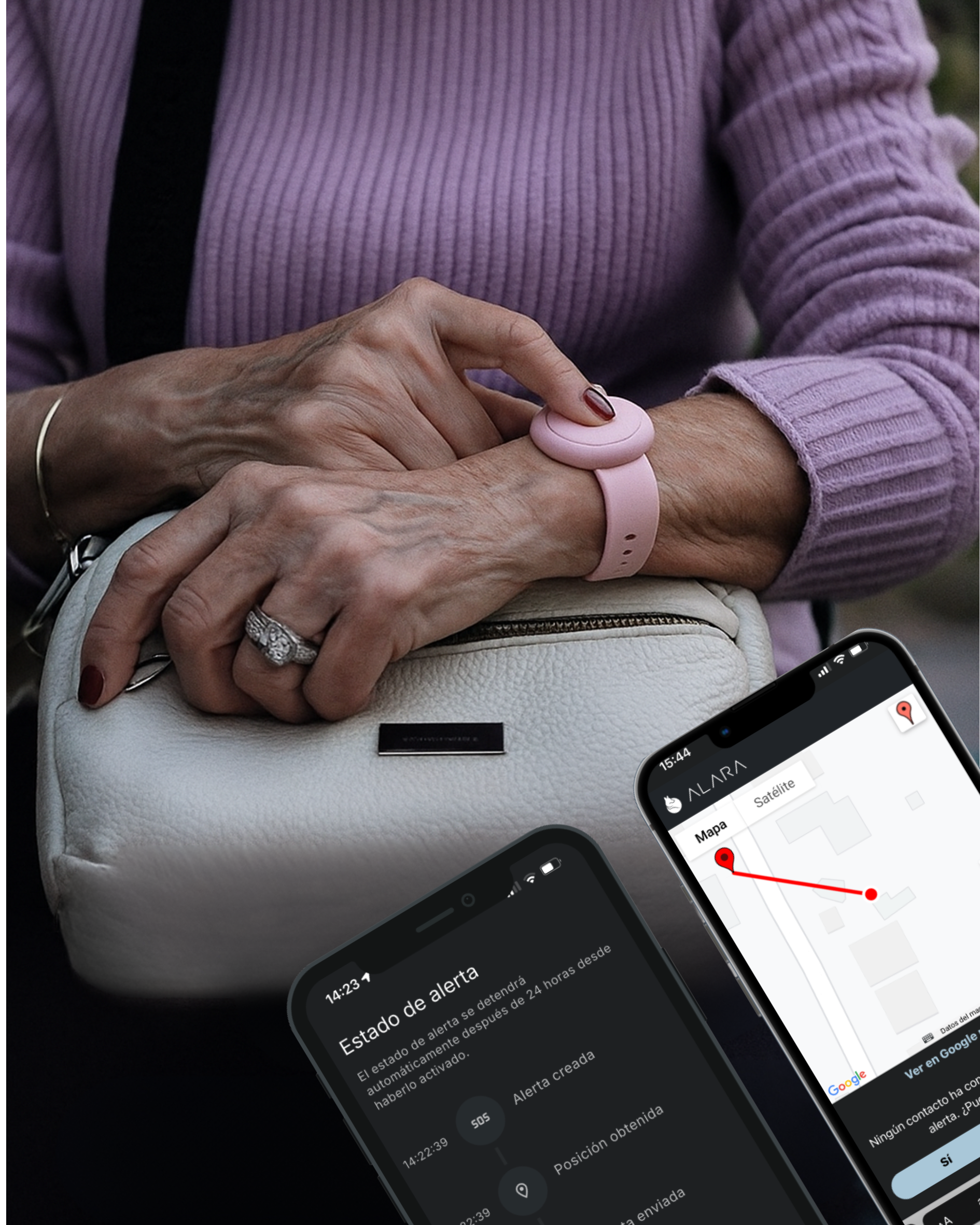
📱 What are they: Discreet bracelet/clip/necklace with panic button
💰 Cost: $30,000-60,000 CLP one time (without subscription)
✅ Pro: Discreet, autonomy (they activate), long battery, non-invasive
❌ Against: Requires remembering to use it
Verdict according to consulted geriatricians:
Option 3 has the highest rate of continued use (78% still using it after 6 months) because respects autonomy.
HOW TO CHOOSE AN ALERT DEVICE: CHECKLIST
If you decided that your family needs one, here are the essential criteria:
✅ TECHNICAL CRITERIA:
- Water resistant (minimum IPX4 = splashes)
- Battery 6+ months (ideally 12)
- No monthly subscription
- Integrated GPS or use the one on the linked cell phone
- Bluetooth Low Energy (BLE)
- Simple activation (2 clicks maximum)
✅ PSYCHOLOGICAL CRITERIA (Most important):
- Does NOT look like a medical device (visual rejection)
- Discreet (don't ask "what is that?")
- Lightweight (less than 30 grams)
- May the alert reach the FAMILY, not strangers in the call center
- No complicated buttons that you will forget how to use
🚨 RED FLAGS (Do not buy if it has this):
❌ Requires "hold 5 seconds" → too complex
❌ It only works inside the house → useless if it falls on the street
❌ Obvious medical design → they are not going to use it
❌ Mandatory subscription → hidden cost that grows
THE CONVERSATION THAT WILL SAVE A LIFE
This article started with a statistic: 1 in 3.
End with a reality: That statistic has a name. It could be your mother's, your father's, your grandmother's.
The good news is that most falls ARE preventable. And when they aren't, the right technology can reduce time on the floor from hours to minutes.
It's not about controlling them. It's about allowing them to continue living the way they want... with invisible support.
The conversation is uncomfortable. But it is infinitely less uncomfortable than the call from the hospital.
📱 Get to know ALARA Senior: The first device designed for older adults who value their independence
Is your family ready?
Don't wait for the statistics. Act before it becomes an emergency call.
Share:
5 Signs Your Dad or Mom Needs an Alert Device (And How to Talk to It Without Offending)
Christmas Gifts for Seniors: Beyond Clothes and Perfumes (2025 Guide)