

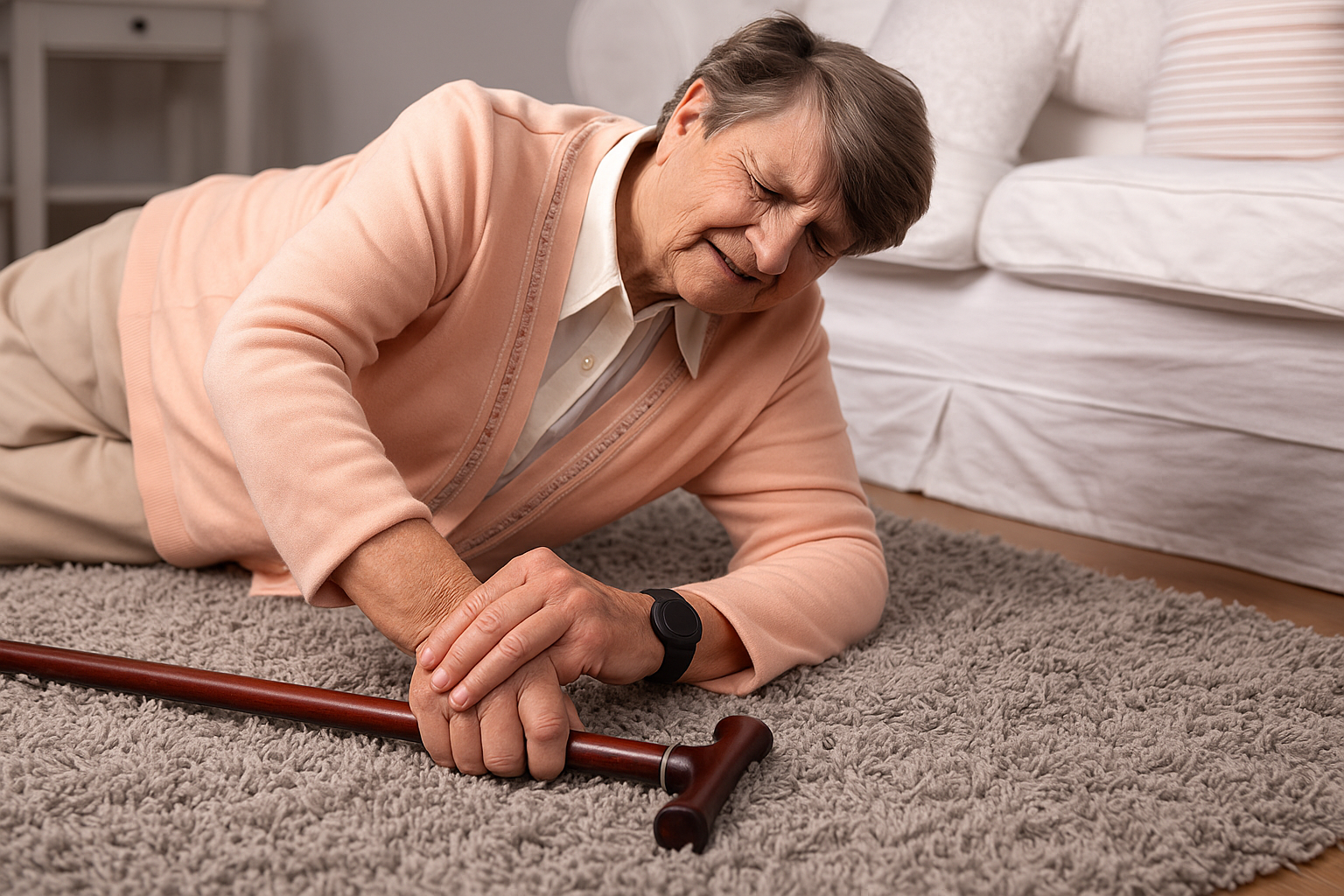
The call came at 11 p.m. "Mom fell in the bathroom and was on the floor for two hours before the neighbor heard her."
If you're reading this, you've probably had that awkward conversation with your siblings: "Do you think mom/dad should have something...just in case?" And you've probably put it off, because how do you tell someone who was independent all their life that they now "need supervision"?
The truth is that It's not about supervision. It's about autonomy with support.
According to data from the Chilean Ministry of Health, 30% of adults over 65 years of age suffer at least one fall per year, and in 40% of these cases, the person was alone for more than an hour before receiving help.
This article is not to convince you that your parents are fragile. It's to help you recognize when a simple alert device can be the difference between independence with peace of mind... and a scare that changed everything.
1. They Live Alone and Go Out Less and Less (But Not by Choice)
The signal:
Before, your mother went to the fair every week. Now he asks you to bring him the shopping. Your dad stopped going to chess club on Thursdays. When you ask, they say "I'm tired" or "it's cold."
Why it matters:
Progressive isolation in older adults is often not due to a lack of desire, but rather due to fear that something will happen when they are alone on the street. A fall, dizziness, becoming disoriented in an area that they previously knew perfectly well.
The difficult conversation:
"Mom, did you stop going to the fair because you don't want to anymore or because you're afraid something will happen?"
How an alert device helps:
With a discreet panic button, they regain the confidence to go out. They know that with a double click, you receive their location in real time. It is not an electronic babysitter; It is an invisible support that gives them freedom back.
2. They Have Had "Minor" Falls That They Minimize
The signal:
"I tripped on the carpet, but it was nothing."
"I got a little dizzy in the shower, but that's over."
"I slipped getting out of the car, but I only had a bruise."
Why it matters:
According to the Society of Geriatrics and Gerontology of Chile, Each "minor" fall increases the risk of a serious fall by 60% in the next 6 months. But beyond the statistics, the pattern is clear: when they minimize, it's because they're afraid that you'll worry... or that you'll start treating them differently.
The difficult conversation:
"Dad, I don't want you to stop doing what you love. I just want to sleep peacefully knowing that if something happens, you can ask for help even if you don't have your cell phone in your hand."
How an alert device helps:
Most falls occur in the bathroom (43%) or on stairs (31%). Places where you are NOT with your cell phone in your hand. A wearable device (bracelet, clip, necklace) means that help is literally attached to them. Two clicks and your cell phone receives: "Dad needs help + exact location."
3. They Take Multiple Medications and Sometimes "Forget" Schedules
The signal:
You find pills from different days together. They say "I already took my blood pressure" but they don't remember the result. You notice that sometimes they are more confused than other times of the day.
Why it matters:
Polypharmacy (5+ daily medications) affects 50% of older adults in Chile according to SENAMA data. Side effects include dizziness, temporary disorientation, and risk of falls. It's not about keeping an eye on them, it's about them having a direct line to you when something doesn't feel right.
The difficult conversation:
"I know you don't like to depend on anyone. That's why this isn't a tracker or a camera. It's just a button. You decide when to use it."
How an alert device helps:
If they feel bad (severe dizziness, post-medication confusion), they don't have to look for their cell phone, unlock it, find your contact and call. Two clicks and that's it. No complicated steps. No technology to learn.
4. Have Had Episodes of Disorientation (Even Brief)
The signal:
"I went to the usual supermarket and for a moment I didn't remember how to get back."
"I was driving and got lost on a street I've known for 30 years."
"I woke up in the night and didn't know where I was for a few seconds."
Why it matters:
These episodes can range from stress and lack of sleep to early signs of cognitive decline. It's not your job to diagnose. But it IS your responsibility to make sure that if they get disoriented, they can get home or you can find them.
The difficult conversation:
"I'm not telling you not to drive. I'm telling you that if you ever feel lost, I want to be able to find you. No drama, no shame."
How an alert device helps:
Some devices (such as ALARA) send real-time location for 24 hours once activated. This means that if your dad becomes disoriented while walking around the neighborhood, it activates the alert and you see exactly where he is. You don't locate it as a tracker; He asks you for help and you respond.
5. You Have Stopped Sleeping Peacefully (And They Know It)
The signal:
You call more often "just to say hello."
You ask them to let you know when they get home (even if they just went to the corner).
You feel a knot in your stomach every time they don't answer the phone the first time.
Why it matters:
This is the most important sign, because It's not just about their safety. It's about peace of mind for the whole family. And when your parents see that you are distressed, they start not telling you things so as not to worry you. Vicious circle.
The difficult conversation:
"This is not to control you. This is for ME. So that I can concentrate on work knowing that if something happens, you will be able to notify me even if you don't have your cell phone nearby."
How an alert device helps:
Change the dynamic from "I'm watching you" to "I trust you to ask me for help if you need it." That psychological difference is enormous. They maintain autonomy. You regain peace of mind. Everyone wins.
HOW TO HAVE "THE CONVERSATION" WITHOUT THEM GETTING ANGRY?
WHAT DOESN'T WORK: ❌ "You're too old to live alone."
❌ "We care about you a lot."
❌ "All your friends have one."
❌ Buy one from them without consulting and surprise them.
WHAT DOES WORK: ✅ "I've been thinking about MY peace of mind, not your ability."
✅ "This doesn't change anything you do. It just gives me peace of mind."
✅ "You decide when you use it. It's your button, not my way of monitoring you."
✅ Show them the device. Let them touch it. Let them see that it is not an ugly medical device.
WHAT TO LOOK FOR IN AN ALERT DEVICE FOR OLDER ADULTS?
Not all devices are the same. These are the criteria according to geriatric specialists:
✅ Make it REALLY discreet
If it looks like a medical device, they're not going to use it. Spot. Look for something that looks like a normal accessory: a clip, a simple bracelet, a keychain.
✅ No monthly subscriptions
Many services charge $15-30 USD/month. In one year it is $180-360 USD in subscription alone. Look for options that work without recurring payments.
✅ LONG lasting battery
If you have to recharge it every week, they will forget it. Look for a minimum of 6 months of battery life, ideally 1 year.
✅ Super easy to activate
No "hold for 3 seconds" or "press button A + B simultaneously." It has to be: two clicks and that's it.
✅ May the alert reach the FAMILY, not a call center
Many services send the alert to a central office that then calls you. That adds up to critical minutes. Better that the alert arrives directly to your cell phone with GPS location.
✅ Water resistant (at least splashes)
43% of falls in older adults occur in the bathroom. They need to be able to use it in the shower.
It's not about controlling them, it's about empowering them.
The irony is that well-designed warning devices They do not limit independence, they expand it.
Your mom can continue going to the fair alone.
Your dad can continue going for walks around the neighborhood.
They can live alone without you calling every 2 hours.
The difference is that they now have an invisible backrest. And you have peace of mind.
The conversation is not easy. But it is infinitely easier than the call at 11 at night.
If you recognized 2 or more of these signs in your parents, it's time to act. Not from fear, but from the love that allows them to remain independent... with support.
ALARA Senior is the first personal safety device designed specifically for older adults who value their autonomy. Discreet, no subscriptions, 12-month battery and activation in 2 seconds.
👉 Get to know ALARA Senior here
Share:
Try the product selected from the 100 most innovative startups of the decade
Falls in older adults: The statistic that every family should know (And how to prevent it)